The 150 Hour / JLPT N5 Requirement for Japanese Language Schools Explained
Important 2026 Update:
From April 2026, Japanese language schools have begun implementing stricter admission screening in line with updated immigration guidance. As part of this change, the previous “150 hours of Japanese study” requirement will no longer be accepted on its own as proof of Japanese language ability. Instead, applicants are now more commonly required to demonstrate ability through official Japanese language test results (such as JLPT) and/or a school-conducted interview or placement test.
Read more: Japanese Student Visa Changes 2026: What Language School Students Must Know
You’ve found a Japanese language school you’re interested in. But then you see it in the requirements: "150-hour requirement" or "JLPT N5 requirement." If you’re wondering what this actually means, you’re not alone. These terms pop up everywhere in Japanese language school and student visa discussions, and they can feel confusing or even intimidating if you’re new to the process.
The good news? It’s more straightforward than it sounds. This guide explains what the 150-hour or JLPT N5 requirement is, why it exists, who needs it, and how to meet it.
Why There Is a Language Requirement for Japanese Language Schools
This requirement exists to help Japanese immigration confirm that:
- You are genuinely coming to study Japanese
- You are not using a language school as a way to work illegally or stay without studying
- You have enough basic Japanese to start structured study in Japan
Schools have their own reasons for enforcing this too. A baseline level of Japanese means teachers can run more effective classes and students won’t fall too far behind their peers. It’s less about gatekeeping beginners and more about setting everyone up for success.
What is The 150 Hour / JLPT N5 Requirement?
The 150-hour Japanese study requirement and JLPT N5 are two alternative ways to prove you have A1 level Japanese language ability before enrolling in a Japanese language school on a student visa. In practical terms, this means you can read basic hiragana and katakana, understand simple everyday phrases, and have classroom experience with Japanese grammar and vocabulary.
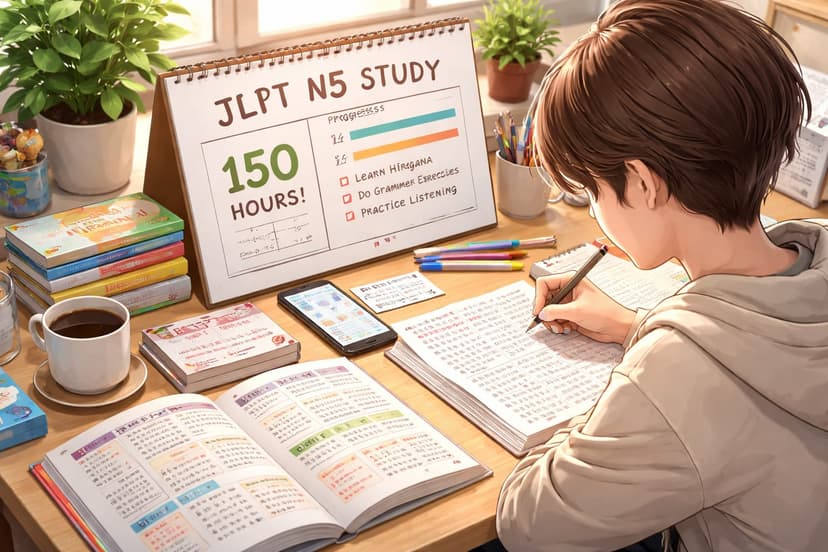
You don’t need to meet both requirements - you only need to choose one path: either complete 150 hours of formal Japanese study or pass JLPT N5 (or an equivalent test). Both prove the same level of ability to immigration and language schools. If you are weighing the test route, our guide on how long it takes to learn Japanese shows roughly how many study hours reaching N5 involves.
How to prove 150 hours of Japanese Study
You’ll need to submit official documentation proving you’ve completed at least 150 hours of Japanese study. The key word here is "official" - not all study counts toward this requirement.
Valid study includes formal Japanese language classes from any accredited institution, whether taken in-person in your home country or online. This is why many people pursue online courses or enrol in language schools before their move to Japan - it’s a practical way to meet the requirement while building their foundation.
The documentation can take different forms. It might be a certificate of completion from a Japanese language course, course transcripts, attendance records, or any other official proof from an accredited language program that clearly shows at least 150 hours of study. The specific format shouldn’t matter as long as it’s official. Self-study, apps without official certification, personal study logs, and unverifiable tutors usually dont’t count.
That said, individual schools may have their own specific preferences or requirements for documentation. It’s worth checking directly with your target language school early in the process to confirm exactly what form of proof they do or don’t need. This way, you can ensure your documentation will be accepted without any surprises during the application process.
How to Prove Japanese ability with JLPT N5 or an Equivalent Test
Instead of submitting a 150-hour study certificate, you can submit a test score that proves you have basic Japanese ability. The Japanese Language Proficiency Test (JLPT) is the most internationally recognized Japanese language test. N5 is the entry-level exam that matches beginner-level skills, and passing it is widely accepted by schools and immigration as proof of basic Japanese ability. For the test format and a study plan, see our guide on how to pass the JLPT N5, and for how N5 sits alongside the higher levels and which one you need for university or work, see our JLPT levels explained (N5–N1) guide.
Other accepted tests include:
- BJT (Business Japanese Proficiency Test): A business-focused Japanese exam; a score of 300 points or higher is accepted as approximately A1-level proficiency.
- J.TEST (Practical Japanese Proficiency Test): A practical Japanese certification; F level or higher, or an FG score of 250+, is commonly accepted as proof of beginner-level ability.
- NAT-TEST: A JLPT-style exam; Level 5 or higher is accepted and is comparable to JLPT N5.
- TOPJ Practical Japanese Test: A communication-focused proficiency test; Beginner A+ level is recognized as beginner proficiency.
- J-cert (Life & Work Japanese Test): A test focused on everyday and workplace Japanese; Beginner level or higher is accepted.
- JLCT (Japanese Language Capability Test): A foreign Japanese proficiency test; JCT5+ is accepted as beginner-level certification.
- PJC Bridge: A test assessing basic communication skills; C− or higher is accepted.
- JPT (Japanese Proficiency Test): A score-based Japanese exam; 315+, or 68+ on JPT Elementary, is considered equivalent to beginner ability.
- JPET (Japanese Proficiency Evaluation Test): A Japanese proficiency assessment; a score of 300+ is recognized by some institutions as beginner-level proof.
The specific test you choose depends on availability in your country and which one works best for your timeline.
Final Thoughts
Now that you understand the requirement, the next step is to decide which path works best for you, 150 hours of study or a test score, and check with your target school about their specific documentation needs. Starting early gives you the flexibility to choose the option that fits your timeline and circumstances. For how the requirement fits the rest of the application, see our student visa process guide, and when you are ready, compare programs in our school directory.